Grounding LLMs: Why Knowledge Graph Quality Sets Your Accuracy Ceiling


Grounding a large language model means giving it verified facts to answer from instead of letting it generate from statistical memory. Everyone building enterprise AI now agrees that grounding matters. Far fewer teams have noticed the harder consequence: once you ground a model in a knowledge base, the quality of that knowledge base becomes the ceiling on the quality of your answers.
You can still buy a few points by swapping models, and you should. But those returns shrink every cycle, while the returns on knowledge quality compound. Past a point, the model is not what is holding you back.
That is a genuinely different engineering problem, and most teams are not set up for it. They stand up a graph, connect it to a retrieval layer, watch accuracy jump, and then plateau — with no clear idea what to fix next. This piece is about what to fix next: the four properties that separate a knowledge graph you can ground on from one that merely exists, and how each one shows up in retrieval, in reasoning, and in whether you can explain the answer afterward.
The ceiling is set by the graph, not the model
Start with the numbers, because they frame everything else.
In Fluree’s April 2024 study, GraphRAG for GenAI Accuracy, we compared how the same set of enterprise questions fared across three retrieval architectures. The setup, so you can weigh the numbers: ChatGPT-4 answering 20 questions that required retrieving from multiple systems at inference time, ranging from a single-table lookup up to joins across nine sources, with five novel questions added after tuning to check that the gains generalized. Each architecture was measured at three levels of effort — zero-shot, fine-tuned with repeated prompting, and finally with the data enriched and joined first.
A decentralized knowledge graph here means a network of independently governed graphs, each source system publishing and governing its own subgraph against shared semantics and joined at query time under access policy — rather than everything being copied into one centrally-modeled store.
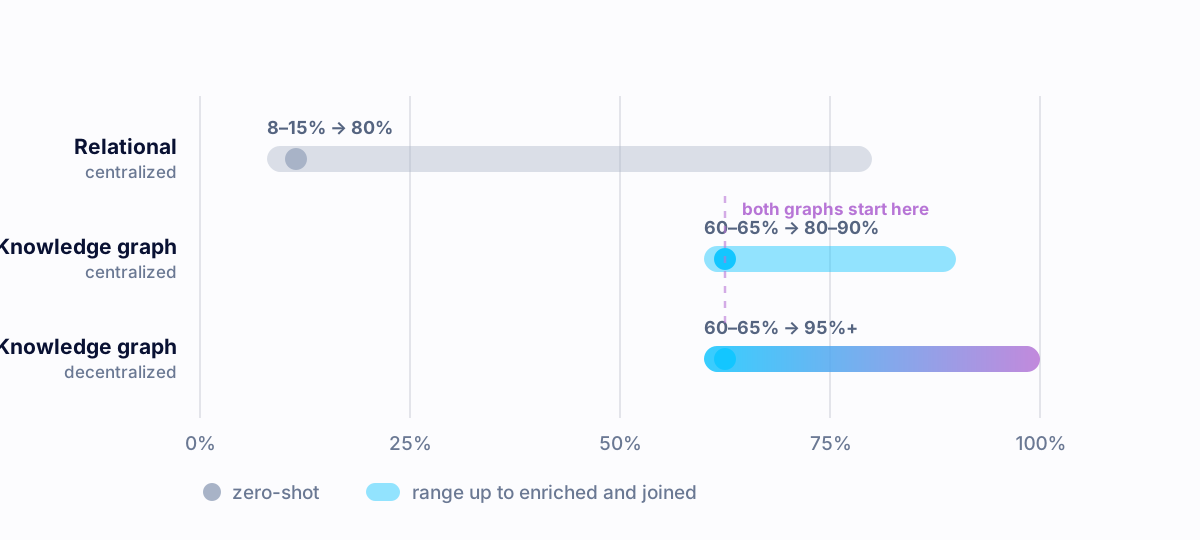
Two things in that table matter more than the headline zero-shot lift.
The first is that moving off relational data buys you a great deal before you have done any tuning at all — 8–15% becomes 60–65% on day one, because the model is reading typed relationships instead of inferring joins across a schema it has to guess at.
The second is subtler and it is the reason for this piece. The two graph rows start in exactly the same place. Zero-shot, a decentralized graph is no better than a centralized one. The gap opens only in the last column, after the data has been enriched and joined — 80–90% against 95%+. Architecture alone bought nothing there; the work done to the data did.
To be precise about what this study does and does not show: it did not isolate the four properties below and test them one at a time. It compared architectures at three levels of effort. But the thing that separates the last column from the first is entirely data work — resolving entities, modeling meaning, connecting sources, keeping attribution — and that is the property set the rest of this piece is about.
This is why “we added a knowledge graph and accuracy is still not where we need it” is such a common second-year problem. The graph did its job — it moved you off the floor. Getting to the ceiling is a data engineering exercise, and it comes down to four properties.
Four properties that make knowledge groundable
One piece of mechanics first, because everything below depends on it. A graph does not store rows. It stores individual statements — this entity, this relationship, that entity — and each statement is addressable on its own. “Acme Corp” hasParent “Acme Holdings” is one statement; “Acme Corp” riskRating “B” is another. That granularity is what makes the rest possible: when a statement is a thing in its own right, you can attach a source to it, validate it, version it, or deny one person access to it without touching anything else. If you are coming from tables, the closest analogy is a row per fact rather than a row per record.
A knowledge graph is groundable when a machine can resolve what a thing is, what it means, whether the statement is valid, and where it came from — without a human in the loop to interpret. Those four questions map to identity, meaning, constraint, and provenance.
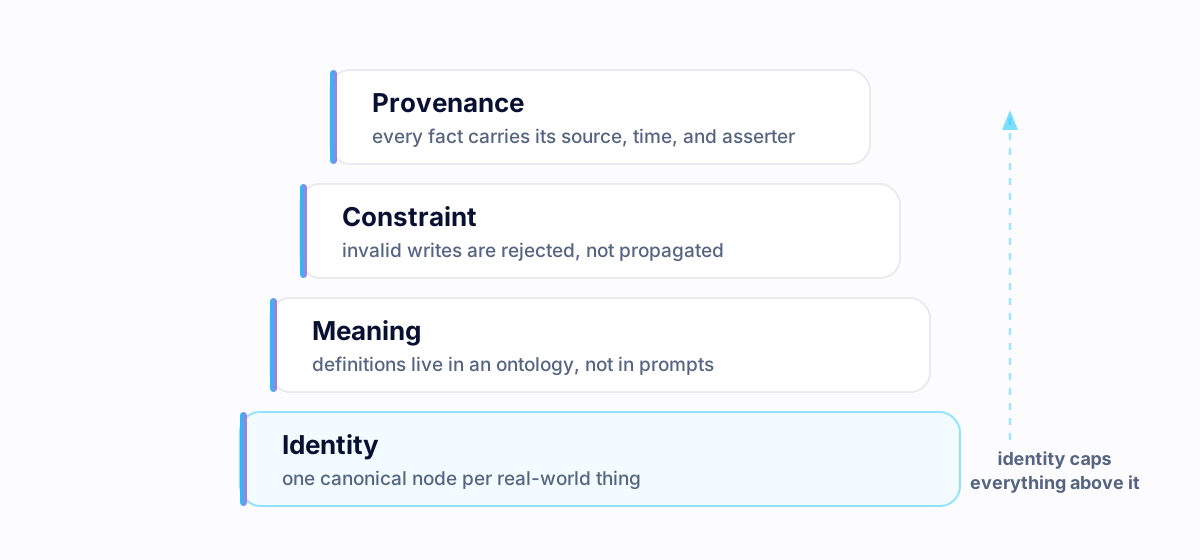
Identity — one entity, one node
The first failure mode is the most mundane and the most expensive. Your CRM has Acme Corp. Billing has ACME Corporation. The support system has acme-corp-1. A contract PDF names Acme Holdings, which is the parent. To a retrieval system these are four unrelated things, so a question like “what is our total exposure to Acme?” returns four partial answers and the model picks one, or worse, sums two of them and double-counts.
Grounding cannot fix ambiguous identity. It inherits it. If the graph has four nodes where the business has one customer, the model will confidently answer about a quarter of your customer.
This is why entity resolution is a grounding prerequisite rather than a data-hygiene nice-to-have. The output you want is a golden record: one canonical node per real-world thing, with the source system identifiers preserved as attributes rather than discarded, so you can still trace which system contributed which fact.
Meaning — an ontology the machine can read
The second failure mode is subtler. Once identity is resolved, the model still has to know what the relationships mean. A column named cust_stat = 'A' is meaningless to a model, and only slightly less meaningless to the analyst who inherited it. An edge typed hasStatus pointing at a node labeled ActiveCustomer, defined in an ontology that says an ActiveCustomer is a Customer with at least one non-terminated Contract, is something a machine can reason with.
The distinction that matters here is between a taxonomy and an ontology. A taxonomy gives you an agreed vocabulary and a hierarchy — useful, and most enterprises have one buried in a governance tool. An ontology goes further: it states the classes, the properties, the domains and ranges, and the logical relationships between them, in a form expressed in W3C standards like RDF that a machine can traverse and validate against.
Without an ontology, meaning lives in three places that AI cannot reach reliably: tribal knowledge, the prompt, and the model’s weights. Prompts are per-application and drift. Weights are opaque and shared across every tenant of the model. Neither is a place to keep your definition of “active customer.”
Constraint — validation as a standing gate
Identity and meaning describe what your data should look like. Constraint is what keeps it that way after the first load.
Every graph degrades. New sources arrive with slightly different conventions, a pipeline changes upstream, a well-meaning integration writes a date as a string. In a document store or a relational warehouse these degradations surface eventually, as a broken dashboard or a failed reconciliation. In a knowledge graph feeding an LLM, they surface as a confidently wrong answer, which is a considerably worse failure mode because nothing looks broken.
SHACL — the W3C Shapes Constraint Language — is the mechanism for this. It lets you declare, as data rather than as application code, that every Contract must have exactly one counterparty, that an effective date must precede an expiry date, that a risk rating must come from a defined set. Writes that violate the shape are rejected at the data layer, not caught three systems downstream.
The reason this belongs in a grounding conversation and not just a data quality one: SHACL shapes are the only part of your quality regime that an AI system inherits automatically. A validation rule enforced in an ETL job protects that pipeline. A shape enforced at the data layer protects every agent, application, and analyst that ever reads the graph.
Provenance — every fact carries its source
The fourth property is the one that turns a correct answer into a defensible one.
Explainability in enterprise AI is usually discussed as a model problem — attention maps, chain-of-thought traces, interpretability research. For grounded systems it is mostly a data problem. When a model answers from retrieved facts, the honest explanation of that answer is the set of facts it retrieved and where each one came from. If your graph stores facts without attribution, the best explanation you can produce is a plausible-sounding paraphrase, which is exactly the thing regulators and auditors have learned to distrust.
Provenance at the fact level means each statement in the graph carries its source system, the time it was asserted, and the identity that asserted it — and that history is not overwritten when the fact changes. That gives you two things a flattened store cannot: the ability to answer “what did we know on the day we made this decision,” and the ability to hand an auditor the actual lineage rather than a reconstruction.
This is the design premise behind FlureeDB, where facts are immutable, time-stamped, and cryptographically verifiable by default rather than by convention. The broader argument for why that matters under audit is in Inside FlureeDB.
How the four properties show up downstream
Each property does distinct work across the three things you actually care about. Being precise about which failure each one prevents matters, because the symptoms look alike from the outside and the fixes are not interchangeable.
The pattern in that table is worth naming. Retrieval improvements are the ones teams notice first, because they show up as better search results. Reasoning improvements are the ones that move accuracy numbers. Explainability improvements are the ones that decide whether the system is allowed into a regulated workflow at all — and they are almost entirely determined by choices made at ingest, long before anyone writes a prompt.
“Won’t longer context windows make this unnecessary?”
The reasonable objection: context windows keep growing, models keep improving at reading messy input, and maybe the whole exercise of curating a graph is a temporary workaround for a model limitation that is about to disappear.
Two things are true at once here. Models genuinely are getting better at reading unstructured input, and that does reduce the amount of pre-processing needed for many tasks. But a longer context window does not resolve which of your four Acme records is the customer. It does not tell the model what your company means by “active.” It does not reject the contract with an expiry date before its effective date. And it does not produce an audit trail — a model that read 400,000 tokens and produced an answer has, at best, told you what it read, not which statements are authoritative or current.
There is also a cost argument, which we worked through in The Tokenomics of Enterprise AI: stuffing more raw context into every call is the most expensive possible way to give a model knowledge, and it scales in the wrong direction as agents fan a single question into many calls.
The durable framing is the one we made in Why AI Needs a Knowledge Graph. Models are rented and replaced; the semantic model of your business is an asset you build once and keep. Gartner reached a similar conclusion from the analyst side, naming knowledge graphs a critical enabler with immediate impact on generative AI in its 2024 Emerging Tech Impact Radar: Generative AI.
Assessing your own graph before you ground on it
If you already have a graph and want to know where your ceiling is, the diagnostic is not “how many triples do we have.” Size is a poor proxy.
The fastest read on which property is currently binding costs you an afternoon. Pull the last fifty answers your system got wrong. For each one, work out which of the four properties failed: was the entity wrong or incomplete (identity), was a term interpreted differently than you meant it (meaning), was the underlying data invalid or contradictory (constraint), or was the answer unattributable (provenance)? The column that fills up is your binding constraint, and it is usually not the one the team assumed.
The questions below are the slower, structural version of the same exercise. They map directly to the four properties above.
A “no” on any of these is not a failing grade — most enterprise graphs start with several. It is a map of where your accuracy ceiling currently sits and which piece of work raises it. In our experience the ordering matters: identity problems cap everything above them, so resolving entities usually buys more accuracy than any amount of ontology refinement on top of a fragmented base.
The same sequencing shows up on the operational side. Teams that treat the graph as a one-time build and the LLM as the ongoing project tend to plateau. Teams that treat the graph as the product — versioned, validated, governed, continuously improved — keep climbing, and they get the semantic layer as a reusable asset rather than a per-application integration.
Frequently Asked Questions
The uncomfortable implication of all this is that grounding moves the hard work upstream. It does not remove effort from the system; it relocates it from prompt engineering, where the gains are capped and per-application, to data engineering, where the gains compound and every consumer inherits them. That is a better trade, but it is a trade: the accuracy you want gets bought with identity resolution, ontology work, validation, and provenance rather than with a better prompt.
If you are working out where your own ceiling sits — which of the four properties is currently binding, and what it would take to raise it — that is the conversation we have most often. Talk to our team, or see how the pieces fit together on the enterprise knowledge graph platform.
Stay in the loop
Weekly insights on enterprise AI, knowledge graphs, and data intelligence.