Building Intelligent Memory for AI Agents: Beyond the Context Window


An AI agent that has been running for six weeks inside your company knows nothing about the first five. It has no recollection of the exception it approved in week two, no idea that the finance team overruled its reasoning in week three, and no way to tell that the vendor record it is about to update is the same one it corrected last month under a different name.
What it has instead is a context window: a working buffer that gets filled at the start of a task and emptied at the end. We call this memory because it functions like memory for the duration of one task. Across tasks, it is closer to amnesia with good note-taking.
This gap is now the practical limit on what agents can be trusted to do. An agent that cannot remember cannot accumulate judgment, cannot be held to a prior decision, and cannot be audited on anything except the transcript of a single run. Gartner forecasts that more than 40% of agentic AI projects will be canceled by the end of 2027, citing escalating costs, unclear business value, and inadequate risk controls. That forecast does not name memory as the cause, and neither will we. But in the deployments we have seen up close, the agent that gets quietly switched off is usually the one that never got better — because nothing it learned survived the session.
The context window is working memory, not memory
The confusion is understandable, because the context window does everything memory does — right up until the task ends.
In human cognition the analogue is working memory: the small, fast, volatile store that holds what you are actively thinking about. It is essential and it is not where knowledge lives. You do not re-derive your understanding of your company’s org chart every time someone mentions a colleague; you retrieve it from something durable. An agent with only a context window is doing exactly that re-derivation, every single run, from whatever happens to be within reach.
Three consequences follow, and they show up in that order as agent deployments mature.
Continuity fails first. The agent handles a request well, then handles a nearly identical request differently a week later, because nothing recorded how the first one was resolved. Users read this as unreliability, which is fair.
Cost fails second. The obvious fix — keep the transcript and replay it — works until the transcript is long, at which point you are paying frontier-model rates to re-read history on every step. We traced the economics of this in Agentic Memory, Priced: because the whole thread is re-read on each call, cost grows with roughly the square of the conversation.
Governance fails third, and hardest. An agent whose only record is a transcript cannot answer “why did you decide that in March,” because the March context is gone and the current context is different. In a regulated workflow that is disqualifying regardless of how good the answers are.
What an agent actually needs to remember
“Give the agent memory” is not one requirement. Agents need at least four distinct kinds of recall, and they fail differently when each is missing. Conflating them is why so many memory implementations end up as a single undifferentiated log that is expensive to search and impossible to govern.
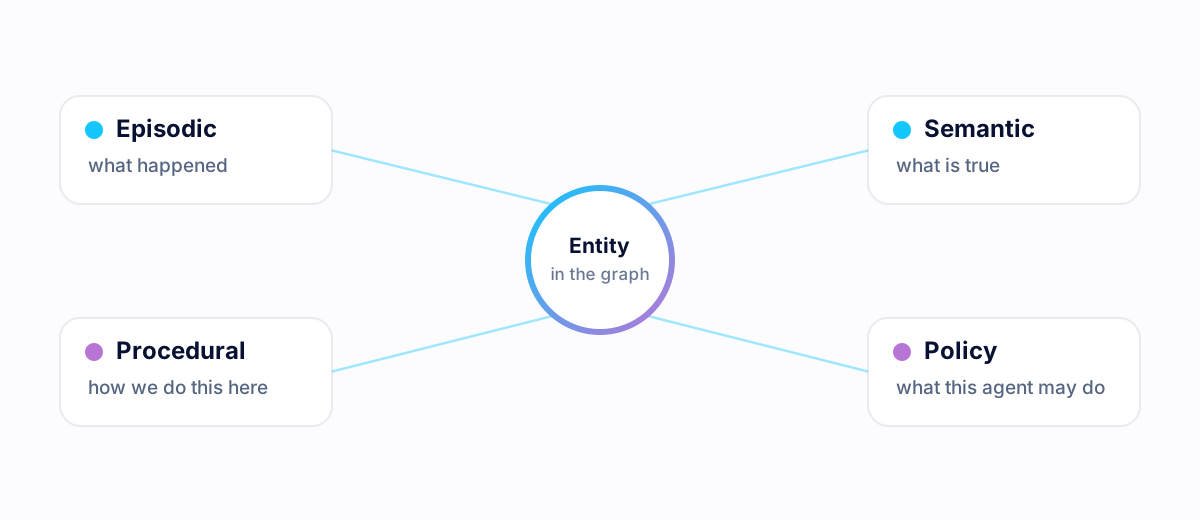
Episodic — what happened
The record of specific events: this invoice was flagged, this exception was approved, this customer escalated, this recommendation was overridden by a human and here is what they said instead.
Episodic memory is what makes an agent improvable. Without it, human corrections evaporate — the agent is told it was wrong, adjusts within the session, and starts the next session with the same disposition it had before. With it, the correction becomes a durable fact the agent retrieves the next time a similar case appears.
Semantic — what is true
The entities, attributes, and relationships that make up the business: who the customers are, which contracts are active, what the current risk rating is, how the org chart is shaped.
Most teams already have some version of this layer, and it shapes answer quality more directly than any of the others. It is also where quality has to be bought rather than assumed — the identity, meaning, constraint, and provenance properties we walked through in Grounding LLMs on Solid Knowledge are exactly the properties that decide whether semantic memory is worth retrieving from.
Procedural — how we do this here
The organizational knowledge that never made it into a document: that refunds above a threshold go to the regional lead first, that this counterparty’s filings always arrive late and that is expected, that the reconciliation runs after the overnight batch and not before.
Procedural memory is the least documented and the most valuable, because it is precisely what a competent new hire spends their first six months acquiring. An agent that cannot hold it will need that six months re-run on every task, by a human, forever.
Policy — what this agent is allowed to do
The constraints: which data this agent may read, which actions it may take without approval, which thresholds trigger escalation, which jurisdictions apply.
Policy is memory in the sense that matters most for autonomy. An agent that must be handed its constraints in every prompt is only as governed as the last prompt someone wrote. An agent that reads constraints from the same governed store as its facts is governed by construction. That distinction is the difference between demo autonomy and production autonomy, and it is the core of what we described as context-in-the-loop.
Why a graph is the right substrate
Given four kinds of memory that need to be stored, related, updated, scoped, and audited, the substrate question answers itself fairly quickly. A knowledge graph provides five properties that a document store, a vector index, and a chat log each provide at most two of.
Facts are typed, not just similar. A memory stored as a typed statement — this entity, this relationship, this value — can be filtered, aggregated, and reasoned over. A memory stored as an embedded paragraph can only be found by resemblance, which is a weaker guarantee than it sounds: semantic similarity has no notion of whether the thing it found is a decision, a constraint, or a stale draft.
Memories connect to the entities they are about. This is the property that makes graph memory qualitatively different. An episodic memory about an approved exception is not a floating note — it is attached to the customer, the contract, the approving identity, and the policy it was an exception to. When the agent later encounters that customer, the exception surfaces because it is one hop away, not because a similarity search happened to rank it highly.
Memories supersede rather than accumulate. More on this below; it is the property that keeps a memory store from becoming a landfill.
Every memory carries provenance. Who asserted it, when, from what source, under what identity. This is what makes agent memory auditable rather than merely persistent, and it is why immutability at the data layer matters — a memory store that overwrites history can tell you what the agent believes now, but not what it believed when it acted.
Memories are scoped. Some memory belongs to one agent, some to a team, some to the whole organization. A graph with governance at the data layer can enforce that an agent reads only its permitted scope, rather than relying on each application to filter correctly. This is the same argument as AI agent governance generally: policy enforced at the data is inherited by every consumer; policy enforced in the application has to be reimplemented by each one.
Supersession is the property nobody plans for
Most teams designing agent memory think about writing and retrieving. Far fewer think about what happens when a memory stops being true, and that omission is what turns a promising memory store into an actively harmful one.
Consider a procedural memory recorded in March: approvals above $50,000 route to the regional lead. In July the threshold changes to $100,000. If the memory store simply appends, the agent now retrieves two contradictory procedures and picks one — probably the one that scores higher on a keyword match, which has nothing to do with which one is current. The agent has not just failed; it has failed while citing an internal source, which is the most convincing possible way to be wrong.
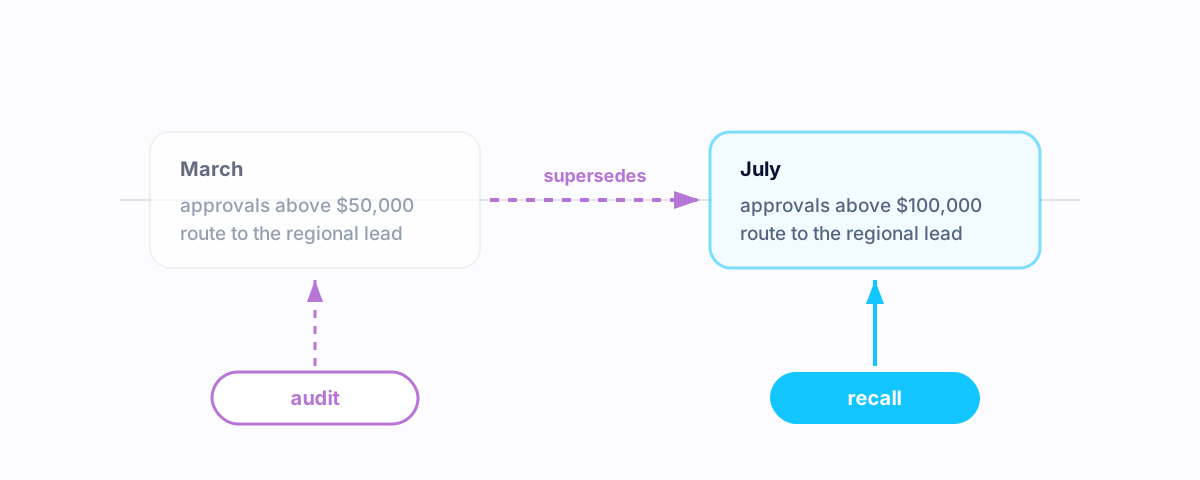
The fix is that updates create a new version explicitly linked to the one it replaces, and recall returns only what is current. Fluree Memory implements this with a mem:supersedes relationship: the superseded fact stops appearing in recall, but the chain is preserved, so you can still reconstruct what the agent knew in March and explain a March decision on March’s terms.
That combination — current by default, historical on demand — is difficult to retrofit and nearly free if the underlying store is immutable and time-aware to begin with. That combination is one of the concrete reasons the substrate choice matters more than it first appears, and FlureeDB builds it in rather than layering it on top.
That third question deserves emphasis. An agent that cannot distinguish its own prior conclusions from verified facts will eventually cite itself as a source and treat the citation as confirmation. Typed memory prevents this structurally: a fact and an inference are different kinds, retrieved differently, weighted differently.
Shared memory turns a fleet into a team
Everything above describes one agent. The larger payoff arrives when several agents share the same memory substrate.
A procurement agent learns that a supplier’s certifications lapsed. A compliance agent, running a different workflow the following week, needs exactly that fact. If memory is per-agent, the second agent rediscovers it — or does not, and approves something it should have flagged. If memory is a shared governed graph, the second agent simply reads it, along with its provenance and the policy scope that determines whether it is allowed to.
This is the practical difference between a collection of automations and something that behaves like an organization. It also changes the scaling math: with per-agent memory, adding agents multiplies the learning cost, because each one has to acquire the same context independently. With shared memory, adding agents amortizes it — the tenth agent starts with everything the first nine established. We sketched the maturity progression this implies in The Six Levels of the Autonomous Enterprise.
The governance argument runs the same direction. A shared memory graph with per-fact policy gives you one place to answer “which agents can see this,” “who wrote this,” and “what did the fleet know on this date.” Per-agent memory gives you those answers n times, inconsistently.
Canonicalize the context once, not once per session
The shared-memory argument has a sharper form, and it is the one that shows up on the invoice.
In the default pattern, memory is local — to a user, to a chat thread, to whichever tool happens to be running. Each session starts empty and rebuilds the context it needs by re-reading documents, re-querying systems, and re-explaining the business to the model. That rebuild is not free: it is paid in tokens, in latency, and in the risk that two people doing the same job get two different pictures because they happened to retrieve different things.
The alternative is to canonicalize the context once. The entity model, the definitions, the policies, the decisions already made — these are resolved a single time into a governed graph, scoped to a team or to the whole enterprise, and every agent reads the same current picture from it. Nothing is rebuilt per session because nothing was thrown away at the end of the last one.
The token consequence is direct. A prompt that no longer has to carry the business context is a dramatically smaller prompt, and in an agentic workflow that fans one question into many model calls, the saving multiplies by the number of calls rather than adding to them. That is the mechanism behind the flat per-question cost line we modeled in Agentic Memory, Priced — and you can pressure-test it against your own seat mix in the Agent TCO calculator.
The consistency consequence is less obvious and probably worth more. When context is canonicalized, “what does the AI think our exposure to this counterparty is” has one answer, and that answer is the same for the analyst, the risk agent, and the report that goes to the committee. When context is rebuilt per session, it has as many answers as there are sessions, and no way to tell which is current.
Memory is what makes decision intelligence possible
Everything so far is about an agent doing its job more cheaply and consistently. The larger return is that a memory graph turns accumulated activity into something you can reason over — which is the actual substance of decision intelligence.
Consider what a governed memory store contains after a year: the decisions that were made, the facts that were true at the moment each was made, the policies in force, the humans who overrode the system and their stated reasons, and — if you connect outcomes back — how each decision turned out. That is not a log. It is a queryable model of how the organization actually decides.
Three capabilities follow that are simply unavailable when memory is a transcript.
Precedent retrieval. When a novel case arrives, the agent can find the closest prior decisions along dimensions that matter — same counterparty type, same policy, same risk band — rather than along textual similarity. The answer to “have we seen this before, and what did we do” becomes a traversal instead of an investigation.
Counterfactual reconstruction. Because facts are versioned rather than overwritten, you can ask what the system knew at the time and separate a bad decision from a decision made well on incomplete information. Those two failures have completely different remedies, and organizations without provenance routinely confuse them.
Outcome-linked learning. When a decision node connects to the result it produced, patterns become visible that no individual case exposes — that a particular exception type reliably precedes a write-off, or that overrides cluster in one region. The graph makes the correlation queryable; a pile of transcripts does not.
None of this requires a separate analytics stack. The agents are already reading and writing this graph; decision intelligence just asks it a different class of question — which is precisely the argument for keeping agent memory in the enterprise knowledge graph rather than in a sidecar store that only the agent runtime can see.
Where to start
Memory is easy to over-scope. The failure mode is a six-month project to build a universal memory layer that no agent uses because no agent was in production to need it. A narrower path works better.
Start with one agent doing one job that a human currently redoes context for. Instrument what it needs to remember, and you will usually find it is a handful of procedural facts and a small set of episodic corrections — not the whole business. Store those as typed, scoped, superseding facts attached to real entities in your semantic layer, rather than as a parallel note store, so the memory inherits the identity resolution and governance you have already paid for.
Then measure the thing that actually matters: whether human corrections stop repeating. If the same override has to be applied twice, memory is not working, regardless of how much is stored. If corrections stick and the agent’s behavior compounds, you have the foundation to add the second agent — and the second one will be cheaper.
Frequently Asked Questions
The through-line is that memory is infrastructure, not a feature of any one agent. Treated as a feature, it gets rebuilt per project, scoped per application, and governed inconsistently. Treated as infrastructure — a governed graph where facts are typed, linked to entities, superseded rather than stacked, and traceable to their source — it becomes the thing that makes each successive agent cheaper and more trustworthy than the last.
If you are working through what that layer looks like against your own agent architecture, talk to our team or explore how it is put together on the enterprise knowledge graph platform.
Stay in the loop
Weekly insights on enterprise AI, knowledge graphs, and data intelligence.