The Neural-Symbolic Loop: Where Data Engineering Meets Reasoning


The most productive enterprise AI teams I talk to have stopped arguing about whether the future is neural or symbolic. They have quietly concluded it is both, and they have moved on to a harder question: how the two halves hand work to each other without a person standing in the middle.
That handoff is the whole game, and it is where most programs stall.
The two halves, and why teams pick one
Neural systems — large language models, embeddings, classifiers — are extraordinary at the things that resist specification. They read a 90-page contract written in a style nobody anticipated. They recognize that “counterparty,” “obligor,” and “the Borrower” refer to the same role. They generalize from a handful of examples to a thousand documents nobody labeled. What they cannot do is be held to a rule. Ask a model to guarantee that every contract it processes has exactly one effective date, and it will comply most of the time, which is a different property than compliance.
Symbolic systems — knowledge graphs, ontologies, constraint languages, rule engines — are the mirror image. They are exact, inspectable, and enforceable. A SHACL shape, defined by the W3C Shapes Constraint Language specification, does not comply most of the time; it either passes or it rejects the write. An ontology does not approximately define “active customer.” What symbolic systems cannot do is read the contract in the first place, or cope gracefully with the input nobody modeled.
Most organizations pick a side, usually by accident. The data engineering group builds the graph and finds it slow to populate and slower to extend. The AI group builds on models and finds the output impressive in the demo and unverifiable in production. Both are correct about the other’s weakness. Both are describing half a system.
What the loop actually is
The loop has two directions, and a program that runs only one of them is not a loop.
Going one way: neural systems build and extend the symbolic layer. Models read unstructured source material — contracts, tickets, filings, emails, PDFs that were scanned sideways in 2011 — and propose structure. Entities, relationships, classifications, candidate mappings from a source field to an ontology term. This is the direction that makes graphs practical to build at enterprise scale, because the alternative is a modeling team working through source systems by hand, which is how knowledge graph projects earn their reputation for taking three years.
Going the other way: the symbolic layer constrains and grounds the neural. Extracted structure gets validated against shapes before it is committed. Resolved entities become the canonical identities that retrieval returns. The ontology supplies the vocabulary the model reasons in, and provenance makes every generated answer traceable back to a source. This is the direction that makes model output defensible.
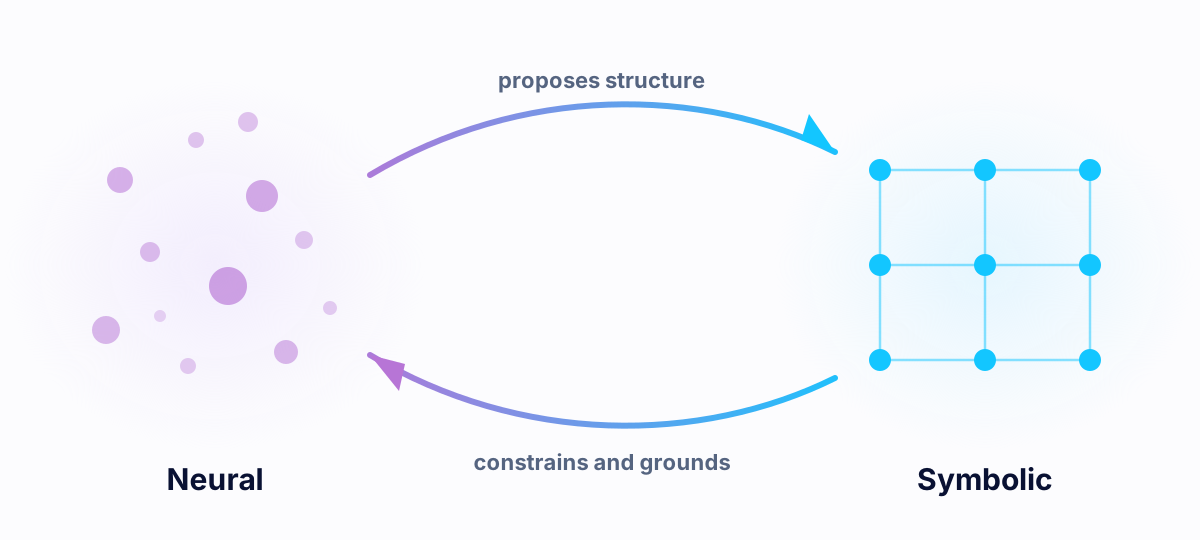
Run only the first direction and you get a graph that grows quickly and drifts — a large, confident, partly-wrong structure that nobody trusts. Run only the second and you get a pristine, immaculately governed model of a small fraction of your business, extended at the speed of committee. The loop is what makes each direction fix the other’s failure mode.
We have described the shape of this before in different language — Model, Map, Connect is the same idea seen from the data engineering side, and the hybrid extraction approach is the loop applied to documents specifically. What follows is what we have learned from running it in production.
Lesson 1: use neural systems to build the graph, not to be the graph
The first instinct, once a team sees how well a model extracts entities from documents, is to skip the graph entirely. Why persist structure when you can re-extract it on demand?
Because re-extraction is not idempotent. Run the same model over the same document twice, and you get answers that agree on the obvious and differ at the edges — a role assigned slightly differently, a date interpreted against a different fiscal convention, a subsidiary attached to the wrong parent. Neither result is wrong exactly. They are just different, and “different each time” is not a property you can build a reconciliation process on.
The teams that get this right treat extraction as a proposal step. The model reads the source and proposes typed statements. Those statements are validated, resolved against existing entities, and committed once — after which they are stable, queryable, and the same tomorrow. The model’s output becomes an asset instead of a recurring computation.
The practical marker is whether your system can answer a question without calling a model at all. If every question requires an inference pass over source documents, you have a very expensive search engine. If most questions are answered by querying committed structure and the model is reserved for language and for the genuinely novel, you have the loop.
Lesson 2: the symbolic layer is where verification has to live
Everyone wants AI output to be verifiable. Very few architectures put verification anywhere it can actually happen.
A model can be asked to explain itself, and it will produce an explanation. The explanation is generated by the same process that generated the answer, which means it is subject to the same failure mode — it is a plausible account, not an audit trail. This is not a criticism of the technology; it is a category observation. Generated text is evidence of what a model produced, not of what is true.
Verification has to attach to the facts, not to the narration. That means every statement in the graph carries where it came from, when it was asserted, which identity asserted it, and which shapes it satisfied — and that prior versions are retained rather than overwritten, so you can reconstruct what the system knew at the moment it acted. When those properties are in place, the explanation for any AI answer is the retrieved fact set and its lineage, which an auditor can check against source systems independently.
This is the argument for putting governance and immutability at the data layer rather than in the application tier, which we made concretely in Inside FlureeDB. In loop terms: the neural side produces claims, the symbolic side is what makes a claim into a record.
Lesson 3: the handoff has to be data, not a document
This is the lesson I would most like to save teams from learning the expensive way.
A very common architecture has the neural side produce a summary, a report, or a JSON blob, which is then handed to the symbolic side — or to the next agent, or to a human — as a document. It looks clean on a whiteboard. In production it quietly destroys the loop, for a reason that takes a few months to surface: a document is a dead end. You cannot validate a paragraph against a shape. You cannot resolve an entity mentioned in prose against your golden records. You cannot ask which of the twelve claims in a summary came from which source. Everything the symbolic layer is good for requires the handoff to arrive as typed statements about identified entities.
The fix is unglamorous and decisive: the neural side’s output contract is structured data in your ontology’s vocabulary, not text. Extraction returns statements with types, subjects that resolve to real entity identifiers, and source attribution per statement. If the model cannot resolve a subject confidently, it says so and the statement is quarantined for review rather than committed with a guess.
The teams that adopt this describe the same experience — the extraction step gets harder and everything downstream gets dramatically easier, because for the first time the symbolic layer can do its job on the neural side’s output rather than on a re-parse of its prose.
Lesson 4: put humans at the schema, not at every row
Every enterprise AI program eventually confronts the same staffing question: where does human judgment go? The default answer — review the output — does not survive contact with volume. If a person has to approve every extracted fact, the system’s throughput is a person’s throughput, and you have built an expensive assistant.
The higher-leverage placement is upstream. Humans should be reviewing and refining the ontology, the shapes, the resolution rules, and the exception thresholds — the artifacts that govern how thousands of rows are handled — rather than the rows themselves. One well-argued decision about what “active contract” means governs every future extraction. One approved row governs one row.
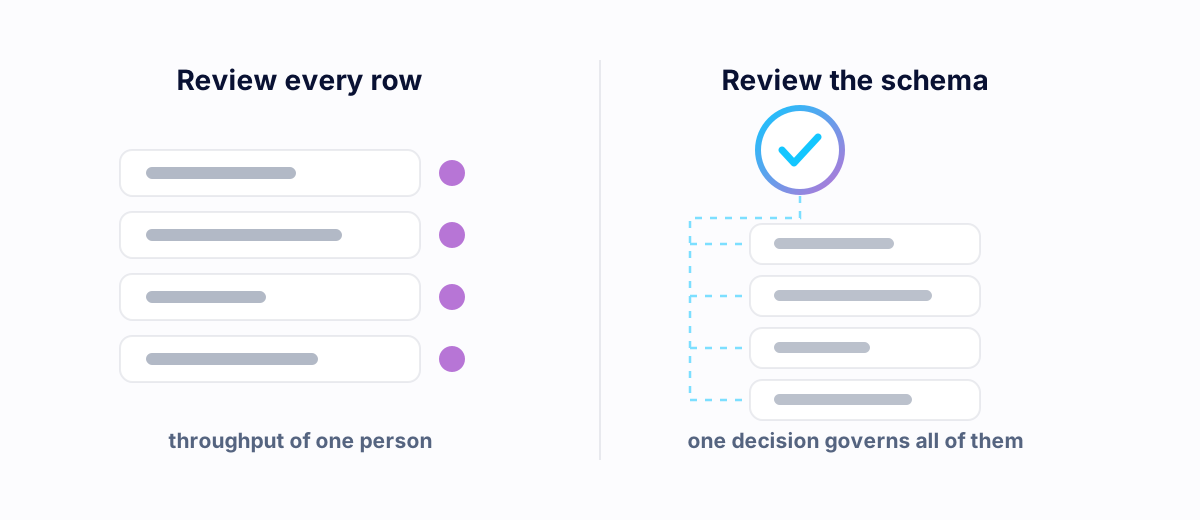
This changes what a data steward’s job looks like, and in my experience it is a change people welcome once they see it. The work moves from clerical adjudication to something closer to policy design. It also changes the review queue from “everything” to “everything the shapes rejected or the resolver flagged as ambiguous,” which is a queue that shrinks as the model of the domain improves. That is the loop closing on the human side: the exceptions of this quarter become the schema of the next.
Reserve row-level human review for the cases the system explicitly cannot decide — low resolution confidence, conflicting authoritative sources, thresholds that carry real risk. That is a defensible use of expert attention, and it matches the layered-control posture the NIST AI Risk Management Framework describes. Reviewing correctly-extracted facts because the architecture provides no other assurance is not.
Lesson 5: close the loop in production, not in a notebook
The last lesson is about where the loop lives. Almost every team builds a version of this during evaluation: extract, validate, load, query, inspect results, adjust. It works, everyone is encouraged, and then the pipeline is handed to engineering and the loop is straightened into a line. Extraction runs on a schedule. Validation failures land in a log. Corrections are made in a ticket queue that nobody reads back into the ontology.
The property that makes it a loop is that what the system learns in production changes the system. A shape that rejects 200 writes a week is telling you the ontology is wrong, or the source changed, or both — and that signal is only useful if something acts on it. A resolver that keeps flagging the same vendor pair as ambiguous is describing a missing rule. Corrections applied by humans are training data for the next extraction pass and, more importantly, candidate constraints for the schema.
Concretely, the instrumentation worth building first is small: validation rejection rates by shape, resolution ambiguity rates by entity type, and the rate at which human corrections repeat. That third one is the single most diagnostic number in the whole system. Corrections that repeat mean nothing you learn is persisting — which is the same failure we described for agent memory, showing up one layer down in the stack.
Where this leaves the architecture
Put the five lessons together and the shape is fairly specific. Neural systems sit at the boundary, where the world is unstructured and specification fails: reading documents, proposing structure, mapping source fields to ontology terms, handling language at the query end. Symbolic systems sit in the center, where correctness has to be enforceable: identity, definitions, constraints, policy, provenance, history. The handoff in both directions is typed data. Humans work on the artifacts that govern many decisions rather than adjudicating single ones. And the signals production generates — rejections, ambiguities, repeated corrections — feed back into the schema rather than into a log.
None of this requires believing that either half is more important. It requires accepting that they are good at different things, and that the interface between them is a first-class piece of architecture rather than an implementation detail. The programs I have watched succeed treat that interface as the thing they are building. The ones that stall treat it as plumbing between two teams that report separately — which is, more often than not, the actual root cause described in technical language.
The quality of what the symbolic side can enforce is bounded by the same four properties we covered in Grounding LLMs on Solid Knowledge: identity, meaning, constraint, and provenance. The loop is how you get those properties at enterprise scale without a three-year modeling project — and how you keep them once the graph is large enough that no one person understands all of it.
Frequently Asked Questions
If you are building on one half of this and feeling the limits of the other, that tension is the useful signal — it usually means the architecture is ready for the interface rather than for more of what is already there. Talk to our team about what the handoff looks like in your stack, or see how the pieces fit together in AI-ready data.
Stay in the loop
Weekly insights on enterprise AI, knowledge graphs, and data intelligence.